Sunday, October 31, 2010

Amelie Short Film Critique

Rationale:
Me and Luke Gray made a comical movie about a man seeking love and pleasure with an already taken girl. The movie revolves around the boy's awkwardness because this awkwardness provides humor to the film, but it also is a common trait that most guys have but try to conceal. This shows what the real boy is like, and that he is not typical cute and perfect boy in regular movies. This film provides humor and romanticism in a way that has only been done in Amelie before, but we believe our film touches more on teenager's outlooks on love.

Commentary:

My job in this project was writer and editor, although both my partner and I edited two different versions of the project. As a writer, i shared my ideas with my partner on how the film should be done and be based upon. The title of my version, "Let me Love You" is also the title of a love song. The lyrics of this song gave me inspiration to what our film should be like. I proposed this idea to my partner and he created a rough draft of the overall story of the film. From there i refined the ideas and gave the main character his awkwardness, which in turn added humor to the film. I will speak of the edits of my film later on in this critique. Additionally, both me and my partner directed the film and put equal contributions to the project and both put an equal amount of time filming.

The main problem that our project encountered was acting issues and being able to acquire actors for the film. If everything had gone accordingly well then my version of the project should have been finished about a week earlier than it was. However, for the first week we weren't able to get any concrete footage. This was because our actors flaked on us during the weekend which was when the majority of filming was supposed to be made. The following Tuesday i found a new actress, but after having read the script she decided not to proceed with the film. Again we had no actor nor actress. Fortunately the following weekend two of our friends decided to act, along with my partner, Luke. Still, we were a week behind the edit and had to dedicate our time to edit outside of class. Also, we had problems with continuity since the weather during the week was quite random -- one day it rained and the next it was sunny. As an editor and writer no extreme problems were presented to me. Editing my only problem was that the film we had captured was both in widescreen and then in 3:4. Luckily my teacher helped me fix this problem and i began editing right away with only amount of time lost.

Casting:

The actors we chose do present the comical feel to the movie. Also the male actor excellently portrays the awkward and lustful character we created. However, neither of the two main actors portrayed a loving character or a love struck character so it was difficult to grasp that from our film even though it was one of our intended characterizations. All of our characters are easily distinguishable from one another so character confusion is not an issue.

Acting:

Our actors easily added comedy to the film. Unfortunately they didn't add romanticism to the film because they couldn't act as a romantic couple. They were too awkward, which was somewhat good since it was an aspect we sought after, but since they were so awkward they weren't able to emulate romantic feels towards one another. It was difficult since the male actor was in a relationship and since they weren't trained actors but simply friends of ours. Still, they did a good job to creating a comical film which was the main aspect that we sought for.

Music:
Music was difficult to find because i had to sort through several amounts of untitled loops and songs to find something that may only be used for about 10 seconds. After about two nonconsecutive hours all of my music was found and i believe that it does add the appropriate tone to my film. There were tones of fear, love, excitement, and goofiness which i believed to be adequate to my film. In my version of the film no sound effects were added. This was because i believe that certain sound effects distract the audience from the video so i didn't use and sound effects. That is why i chose to stick with mood appropriate sound tracks.

Mis en Scene:

In our production we stuck to locations that were familiar to all people like libraries and schools. This adds to the realism of the film. We didn't go to and sewers or closed off locations because that wouldn't fit our film. For example the chances of two different people coincidentally going to the same secluded area or minimal. So we stuck to places that people usually go to. Also, me and my partner were keen to keep certain props out of our shots. Most notably we kept all film equipment out, and we tried to keep our shadows as contained as possible. However, for one certain scene we couldn't keep the shadows out but it isn't very noticeable. Still, it is present and that was an issue that did arise.

Cinematography:

I wasn't the cinematography my partner was and i believe he did an excellent job. In short, he was able to capture a lot of coverage and the shots he made were nicely filmed. I filmed certain shots that he was in but he checked in with me to make sure that the shot was appropriate. Also he did a good job of shooting with the right lighting. He fixed the exposure when needed and we decided to film during the afternoon and morning of days -- when natural illumination is at its peak.

Editing:


Despite having a pretty good cinematographer, there were certain scenes that were too dark to view. So in my edit i added filters to these scenes to brighten them up. In a classroom scene there are extras in the back ground. Extras who we could not control and who tried to ruin the film by making inappropriate gestures and moving in on the back ground of the shots.

So in that sequence i decided to add the video filter "soft edges" to conceal the nuisance. Slowly i increased the density of the edges, and surprisingly, the result made it seem as if the soft edges were intentionally done to add a dream effect to the film. This was perfect since the following scene was indeed a dream sequence. In terms of cutting i made faster cuts than my partner. I did this because i found it boring to keep a static shot on an actor for too long. Boring and unnecessary so i made faster cuts and manipulated speed to minimize the duration of certain long clips. Additionally, i added several cross fade and fades to convey a change in time and a change in scene. Lastly i added certain visual filters to a couple of shots to give them a more dramatic and magical appeal. To the female actor i added soft edges and a glow to give her a majestic and beautiful look. This gave reason to why the boy thought of her, he was attracted to her.

Vector Transition:

Sunday, September 26, 2010

Short Film Treatment

A black figure laying down is seen. Lamp turns on and light illuminates the room. The black figure is a boy. He lifts the sheets off his body and sits on his bed. Clock reveals it is 6:00 A.M. Boy exits his room to the bathroom and when he comes back he is dressed. His eyes are red and his face is pale and weary. He goes to the kitchen and makes a meal, however, he does not eat himself but rather wraps it in plastic. He takes the plate to another room and places it besides his mother on a table.

Boy exits his house and begins to walk. As he walks he coughs slightly, and his eyes are constantly shutting and opening. He arrives at school.

The bell rings. The boy goes to his first class and is greeted by his friends. They are enthusiastic and full of energy, but he is mopey and sluggish. Soon after everyone is seated, his eyes become more and more heavy until eventually they shut completely.

Voices are heard. The boy is nudged awake by another boy. His friend asks him for help with a problem. The teacher is too preoccupied with their life story to ask if their students understand the work. Despite the boy's lack of sleep the boy replies to his friend with a nod indicating a yes. Several other students are asleep in the class. The boy spends the rest of the class period aiding his friend.

The bell rings once more; it is now lunch. The boy rushes to a secluded area of the school. He slowly falls besides a wall and passes out. A minute later his watch beeps which wakes the boy. He recalls that he is supposed to be at a tutoring session in the library. He slowly rises against the wall and yawns. Then he walks to the library where he begins to help students with their studies.

The bell rings; school is over. The boy rushes out of his class. He starts to walk on the same street he walked on when he was going to school; he's going back home.

He opens the door. He is greeted by his little sibling who is nagging at him. He prepares a meal and watches as they eat. When they are done the boy takes the dish and washes it. After he walks back to his mother's room. The plate he made in the morning is half eaten. His mother wakes up. Her face reveals that she is ill. The boy gives her a hug and a kiss and walks back to the kitchen. He makes tea and walks back to his mother's room. She accepts the tea and drinks it after she swallows a pill.

A flashback reveals that the boy's mother is suffering from an unknown virus. The doctor's can't keep her in the hospital because she lacks insurance and because she is no longer working.

The boy looks to the other side of the bed. Something catches his eye. It is a photo. He looks at a picture of himself, his sibling, his mother, and what appears to be his father. The picture fades to reveal only himself, his sibling, and his mother.

The boy walks out outside to check the mailbox. He scurries through the mail hoping to find a special letter. It is unknown what that letter is, however. Rather the boy finds an envelope. The envelope reveals that it is a life insurance check directed to his mother which she receives because her husband died years prior to today.

The boy walks back into his house. He aids his sibling with their studies. Then he prepares dinner for his family, then washes the dishes, and finally does laundry for the household. When he finishes this he puts his mother and his sibling to bed. He walks to his room and turns on a light. The clock reveals it is 12:00 A.M. He begins his homework.

A year passes. The boy is seen. He is as tired as ever. His eyes are bloodshot red and his body looks thinner then before. He is seen going to his mailbox, but this time he has no hopeful look but rather a dismal look. He sees the usual envelopes and walks back towards his house. But suddenly, he brings up the envelopes to his face and shuffles through them once more. He opens one in a hurry. It is an acceptation letter from UC Berkeley that states he will have a fully paid scholarship.

He runs inside home. He tells his mother the good news. She seems to be doing better than before but she still appears feeble. Her eyes reveal that she is immeasurably content with the knowledge that her son will become a successful adult. However, soon the boy and mother are brought back to reality. They both realize that if the boy leave to college then no one will be able to take care of the mother and her daughter. Hope seems lost.

The following afternoon the phone rings. The boy picks up. His face turns from an upset expression into an ecstatic expression. The boy hangs up with tears streaming down from his eyes. He runs to his mother and informs her of the news. Her illness has been researched thoroughly and it now has a cure. In one week's time the mother will be as healthy as ever.

A year passes. The boy is seen walking. For every step he takes his smile becomes wider and wider. Tears flow down his cheeks -- tears of happiness. He walks into his house. The mother is thrilled to see her college son. She makes her family dinner. The boy starts to converse with his mother and his sibling about the college life and his studies at college. He is first in his class. Blackness fades in and the voices slowly fade out.

Monday, September 13, 2010

Amelie Textual Analysis


In the beginning of the story we learn how deprived Amelie was of an average childhood. She was trapped in her home and suffered from boredom and loneliness. Not only did she suffer from this but her fish did as well. So much that it became suicidal. This adds humor to the film as well as characterization to Amelie. By showing that the fish itself is suicidal because of the daily custom routine at home, the director implies that Amelie herself must be yearning for some friendship or excitement. This is why she makes an imaginary friend for herself.

In conjunction the imaginary friend and the suicidal fish add a sense of magical realism to the film. The director does this early on as means to foreshadow Amelie's future. Amelie's adulthood will be filled with excitement and unpredictability on a daily basis. Amelie's life will also be filled with these two elements in effect to the loneliness she dealt with at adolescence. This is proven again later on in the film when the Glass Man speaks of a young woman in his painting. Of course the woman is Amelie who was observed by the Glass Man when she was young. He tells her that he knows she never played with kids either when she was little:

The early characterization is a pathway that explains Amelie's irregularity as an adult, and the director does this majestically to elevate the audience's awareness of why Amelie becomes such a unique woman who loves to place herself in irregular scenarios. The director's clarity is one of his well-known talents that is shown throughout all of his films and it is seen in Amelie as proved by the early yet vivid characterization of Amelie.


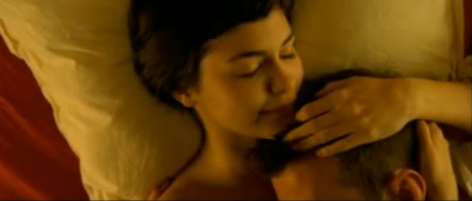
The magical realism is presented again subtly. In the screen shot Amelie is seen looking at her audience because it something she likes to do while viewing movies. This habit seems odd, however, about four other peoples' habits are explained and this oddness doesn't seem so odd anymore. Rather it shows how the supposed "average" person is actual a unique person and that everyone in the world is different. I believe that it's magical that this director is the first person to exhibit the usual person in a manner that has never been presented before. Furthermore, these habits add to realism as well once it becomes clear that the habits can belong to any person. Therefore, this film isn't as far fetched as it may have appeared earlier in the story. However, throughout the director still applies his magical feeling to his film in several scenes. This is done to enforce Amelie's characterization since all of the wacky things occur in her own city and to whomever she thinks about. Furthermore, the magical feel forwards the plot in some cases and adds a Hollywood-esque feel to the movie.

The narration tells the audience that both Amelie and Nino longed for a brother or sister to play with. They long for this since both Amelie and Nino didn't have a chance to play with kids when they were young. Amelie couldn't because of her family, whereas Nino couldn't because everyone at his school bullied them. This back story of both of them foreshadows that they will both marry and finally have someone to share their life with and in turn diminish the loneliness they felt during childhood. It can be predetermined that this will occur since it is common knowledge that the director is making a classic Hollywood style movie in which everyone who deserves good fortune shall acquire it whereas anyone who is malignant shall receive punishment nearing the end of the movie.

Both Amelie and Nino suffered from a somewhat rough childhood but in the end they both got what they wanted -- each other. This reinforces the classical Hollywood ending of course and also supports the theme of justice in the film.


Throughout the film the story contains several subplots. There's the subplot of Amelie returning the box of memories to its rightful owner. Also the subplot of the marketplace owner torturing his young worker in a humiliating manner. Justice can be seen in both cases, however it is more predominant in the latter case. But in the first, the man who the box of memories belongs to was living in an empty and somewhat pitiful manner. However, once he receives his box, which is a symbol of his youth, he become jubilant and much more happy about his life and about living each day. Because of this, he starts to spend time with his nephew who in a way becomes his own apprentice. The uncle gives him the best piece of the clean chicken. For the last several years the uncle bought a new chicken once a week and took pleasure in cleaning it and eating every piece with happiness. But justice came in the form of him giving his nephew the best piece of the chicken since he relearned that happiness should start during youth and continue throughout the person's lifespan. If a parent or anyone doesn't provide a happy environment for their young companion or child then they will live with emptiness forever and will suffer. This is what happened to Amelie's dad who to his knowledge had a traveling gnome. The second example is the man from the marketplace. Amelie performs several mischievous acts upon him that severely irritate him and cause him to go insane. This is his justice for mistreating and constantly disrespecting his young worker.

Thursday, April 1, 2010

Blog Post- March 11


A taxi driver who finds a teddy bear on the street and decides to give it to his daughter. He appears to care about her very much as he tucks her in and kisses her.


Unfortunately, the teddy bear is evil which causes the seemingly innocent girl to become crazy and kill. She was hospitalized and escaped and a box appears to have possessed her.


The conflict is that the bear turned out to not be a good gift after all. Ten years after the girl gets the bear. She is holding a knife, is wearing a hospital robe, is drenched with blood and still has the bear in hand. The film ends with the girl disappearing along with the box and the teddy bear being the only thing left.

The ending gives the audience the feeling of horror and tension seeing as how a completely innocent girl became a psycho killer.

Blog Post- Reverie and the DSLR Revolution


The lighting in this film is incredible. The camera was used at night and the visual looks like something that the human eye would see, not a camera. There is clear and crisp detail on the two actors who are lit equally and also the backround is lit well which adds beauty to the scene. The ocean water can also be seen. It appears to be lit by the moonlight and it looks gorgeous. The city looks majestic and magical and the woman isn't lit to hide her identity for a moment. However, her backround is lit which emphasizes her. This can also be selective focus as it appears that the woman is blurred out which may be the real reason that her profile is dark.


Going back to the focus, the camera appears to be very smart and know what to blur and what not to blur. In this shot everything but the mirror is heavily blurred which creates emphasis on the person himself. Since the blurs attract the human eye to see what is in focus. This camera is really nice it is definitely the camera of the future.

Friday, March 5, 2010

Blog Film Review- 2-24-

The trailer for Solitude is about a couple of kids graduating from high school and getting ready for college. They go on a trip to a remote location near a desert. They soon find that all of the houses around them are empty and no one even travels near them. A phone ring but no one answers. One by one the kids go missing until finally the girl sees her friend being tortured behind her. She screams.


Textual Analysis

Mis en Scene - The framing in this trailer is very tight. The actors have no room to move. This helps create a feeling that the characters are trapped. They have nowhere to go. They are trapped.

Editing – the trailer uses many fade in and fade outs.This is done to create a suspenseful feeling in which the duration of the fade ins and fade outs are roughly long and increase tension.

Motion - the director uses high angle shots and slow placed action scenes to add mystery and suspense to the trailer

Sound - the sound uses several kicks and heartbeats to create a frightful setting. The audience knows that danger is lurking and can only wait until the dreaded horror comes. Suspense builds to the wait and adds to the fear in the audience.

Thursday, January 21, 2010

Avatar Criticism Post

1. The challenges presented in Ava†ar include the visuals and story telling. The avatars actually look like their human counterparts which is slightly creepy but it is fantastic because it makes the movie seem much more real and possible. This is the first movie to take a human model and matte them onto an animation and have them move in real time and with real human traits such as facial expressions. Although it is not an animation because the character on the screen is moving and looking just like the actual human.
2.Well the film maker had to do several extras in the movie which is what makes the movie so great. A new language was created for the Na'Vi people and they were given their own mythological backround. So within this story are several other woven substories that help explain the backround of Pandora. The world of Pandora has its own creatures, its own way of life, a toxic atmosphere making it uninhabitable for humans, its plants communicate and have a glow which give the world a beauty. Pandora's name was taken from the term Pandora's box in which all knowledge of life could be found. The world and the movie is very detailed and looks very real.
3. Motion suits with several points on them are used to give the character movement. Then a camera is mounted on the head to look at the face of the actor so that the animators can see the human expressions and translate them onto the character. The cameras capture the actors and translate their physical movement into the CGI character.
4. The film cost $400 million dollars to make and market. The fact that the film cost so much money hurt the company and made some investors fear that if the movie bombed their money would be lost. That scared away some investors but the positive reviews boosted stock revenue by 12% and the success of the movie is boosting stocks as well. The movie was definitely worth the risk of making and the message conveyed is that a dream to make something fantastic at a high price will pay off if the dream is done with careful preparation and effort.
5. I agree with the critic's claim that Avatar "identifies the profound spiritual bankruptcy that underlies our financial insolvency...and reminds us (to)... make new choices for the greatest good of all". This is because the film takes place on a lavish and rich world where great wealth can be gained. This greed is a prime example of imperialism since Europe colonized several countries to gain economic success. The habitants of Pandora do now care for wealth they just care to maintain their culture and happiness. Money means nothing to them which is seen since they wont move away from hometree for any price that the humans will pay. What the humans want is not what the people want. Cameroon is trying to instill the Na'Vi ideals into us because humans are so wrapped up in greed and dividends that we will do anything to get money. Even use racism to justify our reason to gain money. In the end money does not win but moral goodness does. The Na'Vi people are able to defend themselves from the humans and they force the humans to leave. Perhaps the humans in the film have learned their lesson. Hopefully we will too.